So let’s look at who we are talking to. First, we are addressing the patient. If you are a patient, this space is not meant to frighten you. But to be honest. That is such a tricky balance to strike. It implies that the honesty of surgery is frightening. I’m going to be honest about my mistakes and my uncertainty, I might be a little frightened. Of course. But consider the alternative. The alternative is the comforting lie. Everything is under control. Nothing can go wrong. Right. That is what we want to hear, but it isn’t the truth. And deep down, I think every patient knows that. We are treating the patient as an adult who can handle the reality that medicine is difficult and uncertain. It’s a deeper form of trust than just assurances. It’s respecting the patient enough to show them the messy backstage.
Okay then, we will address the student or trainee. If you are a student or a trainee, the space is not meant to impress you, but to prepare you. In academic medicine, there is so much posturing. The Peacock Show. Look at this rare case I solved. Look at my perfect bloodless technique. It’s about impressing the hierarchy. It’s about the God Complex. Its performance. It is. But no, I’m not here to show off. I’m here to prepare you. For the fatigue. For the doubt. For the moment the anatomy betrays you and the map is useless. It’s mentorship versus showmanship. They’re teaching the hidden curriculum, emotional resilience, and psychological coping skills you don’t find in textbooks.
And finally, the third group, the professional. The peer. Yes. If you are a fellow professional, perhaps some of these words will feel familiar. That is the call for connection. The silence of the operating theatre. It can be a very lonely profession. You’re surrounded by people. But you are alone in your decision-making. You are the one holding the knife. The final responsibility is yours alone. It’s lonely at the top of the table. It is. And many surgeons suffer in silence because they think, if I feel sad about this or if I feel scared, I must be weak. I must be unfit for the job because everyone else seems so confident. Right. By saying perhaps these words will feel familiar, we are reaching out into the void and saying, you aren’t the only one. We all feel this. It’s creating a community of shared experience where usually there is just silence and competition. It validates the private emotional experience of their peers. It’s a generous act.
These beginning thoughts are very ceremonial. It is. It mirrors the ritual of surgery itself. It’s deliberately simple, like the first incision of the day, clean, intentional, and respectful of what lies beneath. In surgery, the first incision defines everything that follows, right? It sets the tone. It defines the exposure you’ll have. If the first incision is jagged or in the wrong place, the rest of the surgery becomes harder. You are fighting your own opening for hours. So it has to be clean. It shows a clear mind, a steady hand. And intentional. A surgeon cannot hesitate. They must be decisive. There’s a moment of commitment. But what lies beneath is the most interesting part of that for me, the vulnerability of their body. You are violating the body’s integrity to save it. You have to respect that violation. It’s a sacred trust. What lies beneath is the truth, the emotion, the raw reality of the experience.
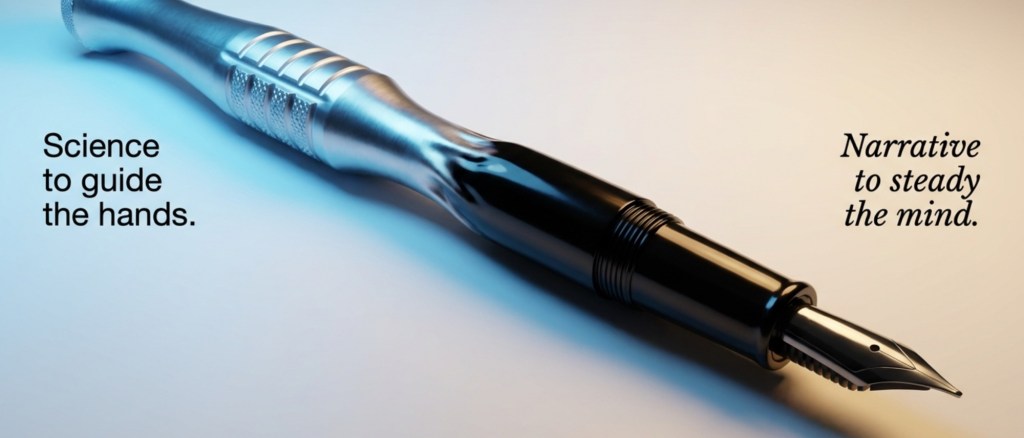
Also, it’s a promise of ethical storytelling. It’s a Hippocratic oath for writing. The surgery is over. The reflection begins. It feels like taking off the mask or scrubbing out at the end of a long case. It is the shift from the actor to the observer, from the operator to the narrator. The act of picking up the pen is the act of healing the surgeon. It’s an invitation. It’s permission to acknowledge that the official record isn’t the whole story. It’s a reminder that to be healthy, to be steady, we need to find a way to let that accumulation out. We need to find our own version of the pen. That is where I want to leave everyone today. A final thought to mull over. Go for it.
 Siddhartha Phukan – My Surgical World