The Throne of Fire: Napoleon’s Secret Enemy at Waterloo
Most history books tell the story of Waterloo through the lens of grand strategy: the clash of empires, the muddy slopes of Mont-Saint-Jean, and the tactical genius of Wellington. We are taught to look at the oil paintings of Napoleon Bonaparte—the “Man of Destiny”—and see an untouchable god of war. But there is a version of June 18th, 1815, that isn’t found in the heroic murals. It is a story not of cannons and cavalry, but of a secret, agonising physical collapse. Before a single shot was fired, the master of Europe was already losing a war against his own body. To understand why the map of the world changed that day, we have to look beneath the gold braid and the legend, down to a tiny, inflamed vulnerability that brought a conqueror to his knees.
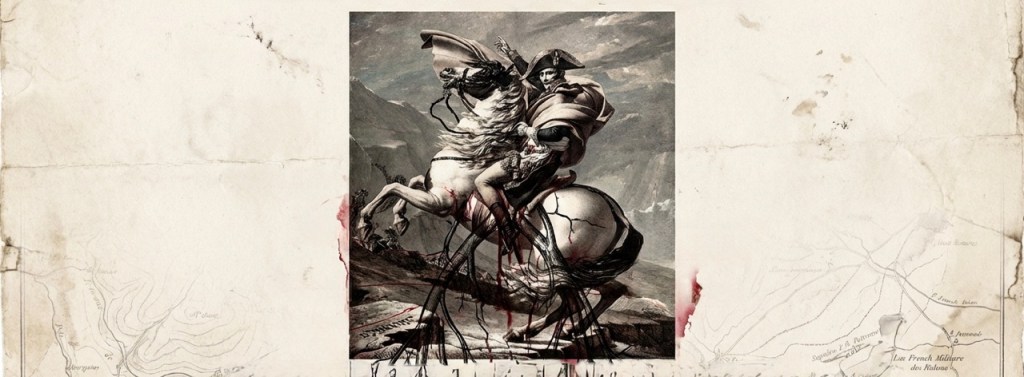
A single day determined the fate of 19th-century Europe. When we think of it, we picture the legendary figure – the man of bronze and marble. The enduring brand is the iconic paintings by Jacques-Louis David. Imagine Napoleon astride his rearing white horse, likely Marengo. The horse’s wild eyes and tense muscles contrast with Napoleon’s perfect calm amidst the storm. His red cloak billows like a cloud as he points towards destiny. His blazing eyes command the Grande Armée with unwavering will. This is the ultimate image of the conqueror – a god of war designed to convey his superiority over human concerns, gravity and most importantly, pain.
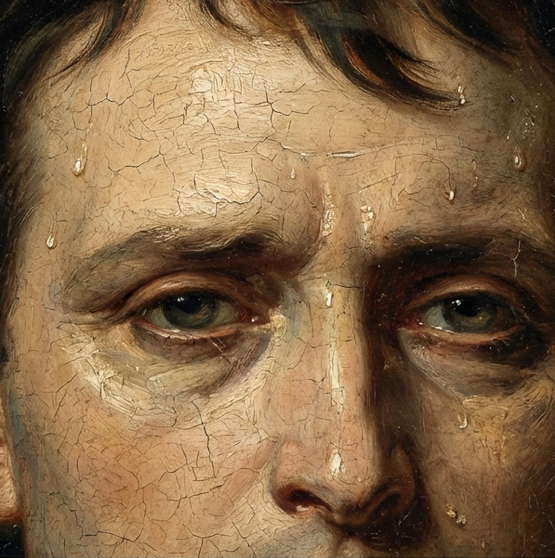
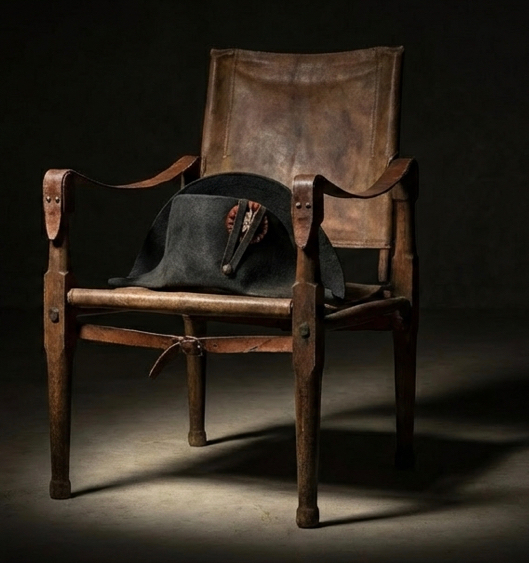
Imagine zooming in on the reality of that Belgian morning. You won’t find a god, but a middle-aged, overweight man slumped on a cheap folding camp stool. His face isn’t ablaze but a mask of grey porcelain. Sweating and shifting his weight constantly, he’s physically unable to sit comfortably.
The central conflict of Waterloo wasn’t just between Napoleon and the Duke of Wellington. The real battle, potentially deciding the outcome before a single shot was fired, was between the Emperor and his own anatomy. It feels almost wrong to say it: the Emperor of the French defeated by piles? It sounds like a bad joke from a satirical cartoon of the era. But it was a secret wound that turned every movement into a lightning strike of agony.
The Predator Paralysed
Napoleon wasn’t a “command-and-control” leader; he was a shark. He thrived on movement and his reputation was built on swift marches and unexpected manoeuvres that bewildered his enemies. His leadership style was intensely physical, and he was renowned for riding the lines personally surveying the ground and even adjusting artillery positions himself. She could sense weakness in an enemy line like a predator. Napoleon had to be everywhere at once – that was his “Napoleonic magic”. His soldiers affectionately called him the “Little Corporal” because he was always in the mud with them. His physical presence was a force multiplier. For a man whose entire identity was built on speed being chained to a chair wasn’t just painful; it was a tactical disaster.
The Medical Nightmare of 1815
To grasp the terror Napoleon endured, it’s crucial to understand the medical tools available to him. His surgeon, Dr Dominique-Jean Larrey, a brilliant pioneer of modern triage, operated in 1815 without anaesthesia. The likely diagnosis was a thrombosed haemorrhoid, a blood clot causing acute swelling and pressure. Described as “pulsing with the dull insistence of mortality,” it demanded a treatment akin to medieval torture.
The surgical arsenal included:
– Bistoury: A curved scalpel for deep tissue incision.
– Haemorrhoidal Forceps: Heavy iron clamps to seize and crush inflamed tissue.
– Actual Cautery: A branding iron, not a chemical, pressed against sensitive nerve endings.
Napoleon was familiar with these tools, having witnessed their use on his soldiers for two decades. He understood that surgery involved being restrained by strong men while a surgeon applied fire to his flesh.
The Fatal Delay
This brings us to the most crucial military debate: why did Napoleon delay? Remarkably, the battle didn’t begin until 11:30 a.m. contrary to his preference for dawn strikes. The prevailing narrative is the “mud argument”: he waited for the ground to dry so his cannonballs would bounce. However, a deeper theory suggests the delay stemmed from physiological factors. Napoleon was incapacitated; he couldn’t mount his horse or think clearly.
He likely awaited the effects of laudanum. A tincture of opium and alcohol, laudanum was the most potent painkiller available but came with a price: drowsiness foggy thinking and detachment. In modern military terms, it disrupted his OODA loop (Observe, Orient, Decide, Act). His “processor” was sluggish. While his brain buffered the situation the window of opportunity closed. Those five hours allowed the Prussians to arrive and turn the tide.
The Battle from a Chair
As the fighting commenced, the disconnect deepened. Napoleon attempted to mount his horse twice but each time the pressure against the saddle jolted him so painfully he nearly fainted. Forced back to his chair two kilometres from the front, he became a “blind commander.” The smoke and tall rye crops obscured his vision, leaving him reliant on secondhand messenger reports. This oversight led to the disastrous cavalry blunder where Marshal Ney, acting without supervision, threw 10,000 horsemen into a suicidal charge against British squares. A healthy Napoleon would have ridden to the ridge and halted the madness. Instead, the Napoleon of Waterloo remained in the rear gripping a wooden stool.
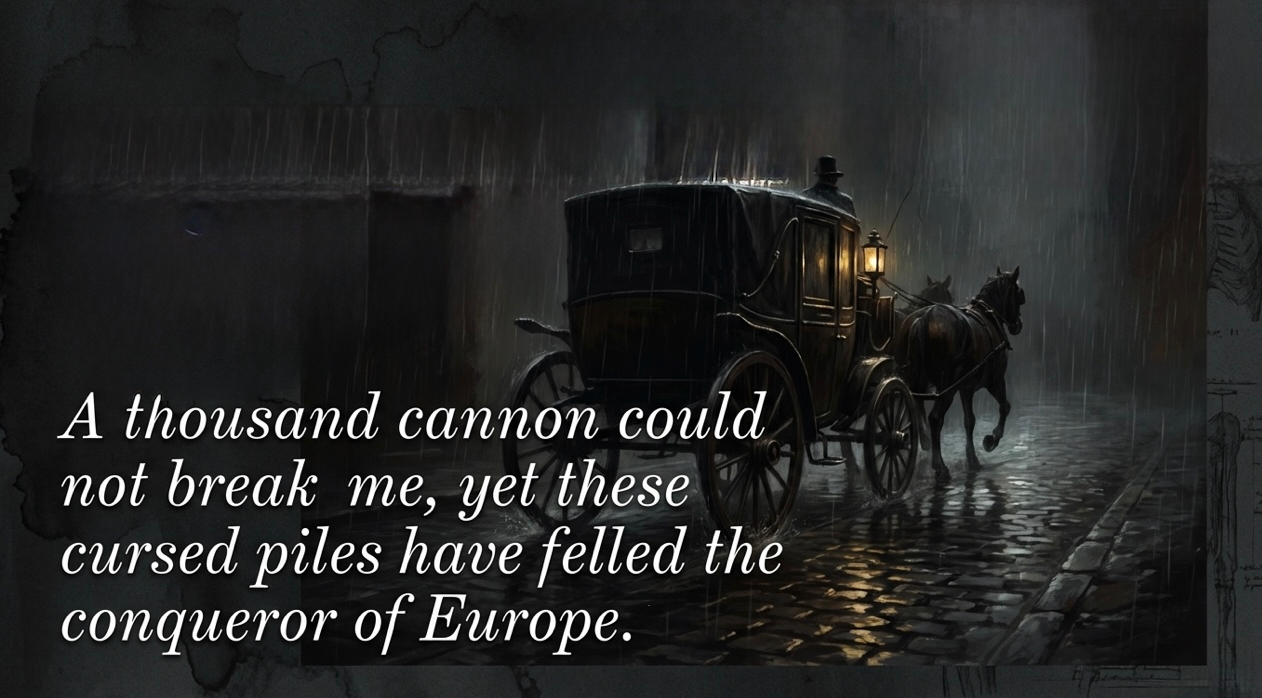
When the Imperial Guard finally broke and the retreat began, the final indignity arrived: the carriage ride. Without shock absorbers in 1815, Napoleon was bounced over Belgian cobblestones and ruts for hours, a rhythmic torture that reportedly moved him to tears. Later he lamented to his aides, “A thousand cannon could not break me yet these cursed piles have felled the conqueror of Europe.”
The Democratic Truth
We often believe history hinges on grand ideas like liberty, tyranny or military genius. However, the truth is that history is frequently shaped by the delicate workings of human biology.
There’s a “democratic truth” to this: no amount of gold or crowns can shield a leader from their own biology. For example, the map of Europe was rewritten due to a mere few centimetres of inflamed tissue. This perspective shrinks the epic down to a human scale.
The next time we examine a significant decision or a disastrous law, perhaps we should look beyond official records. We should peer beneath the uniform and crown to the blood and tissue beneath. After all, that’s where history—painful, messy and unglamorous—truly unfolds.
Waterloo teaches us a messier, more human lesson. It reminds us that the course of nations can be diverted by something as small as a blood clot or a misplaced medicine chest. Napoleon’s fall didn’t require a silver bullet; it only required a few hours of delay and a mind clouded by opium and agony. History isn’t just made of big ideas; it’s made of flesh, blood, and the occasional, world-altering moment of human frailty.
 Siddhartha Phukan – My Surgical World
Leave a comment