“We are obsessed with the idea that humanity is the protagonist of the earth’s story, but an encounter in the deep woods reminds us that we are merely guests in a theater overseen by older, quieter gods.” — Elias Thorne
There is something quietly unsettling about a forest that is watching you back.
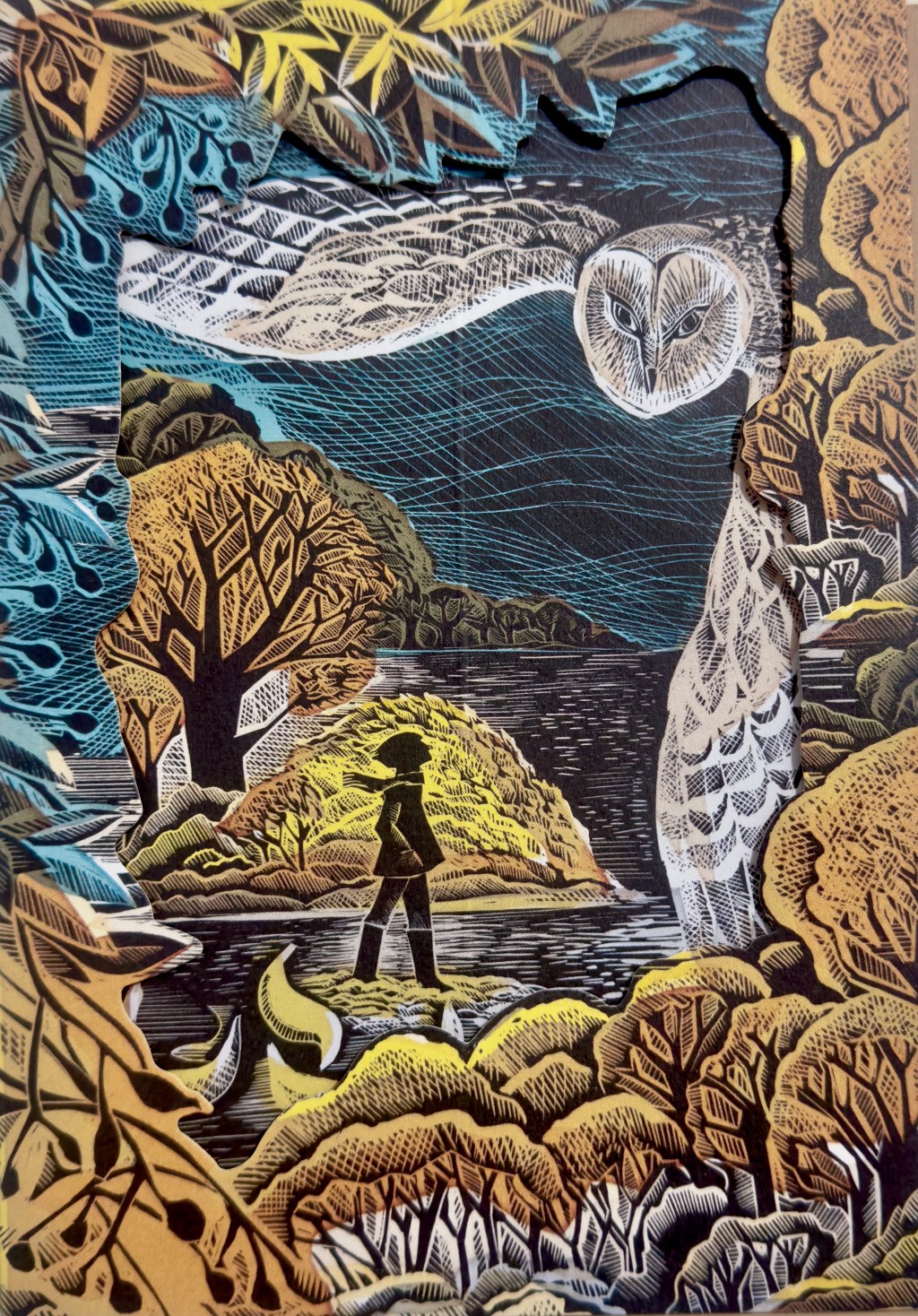
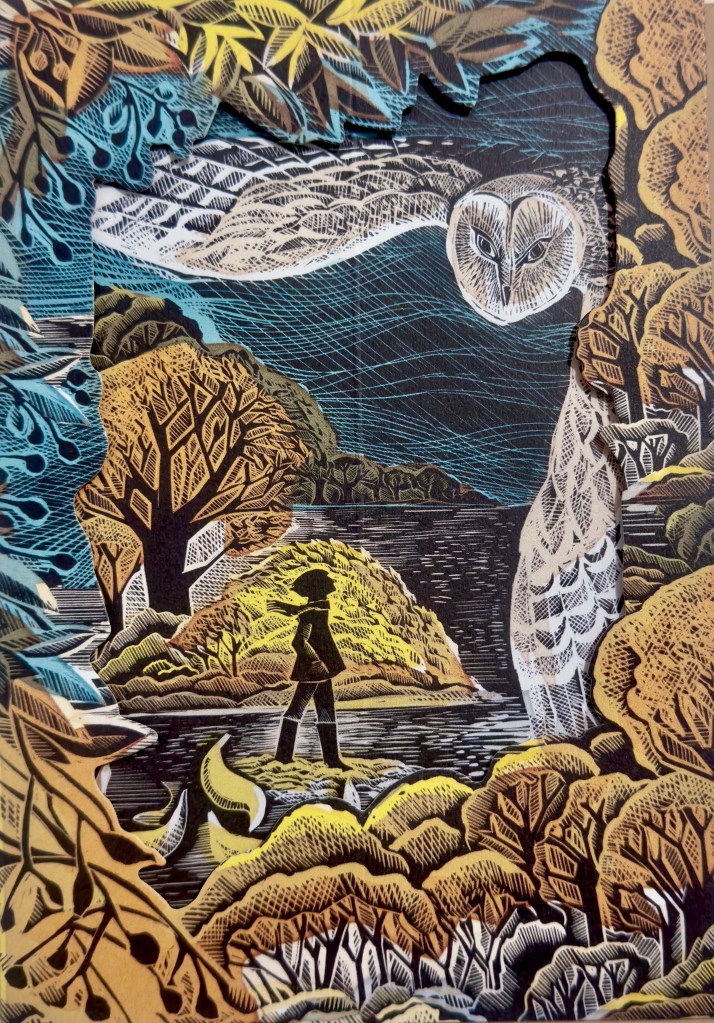
At first glance, the scene appears almost pastoral—a lone figure stands at the edge of a lake, framed by dense foliage and sculpted hills. The waters ripple in fine, rhythmic lines, reflecting neither sky nor certainty. The symphony of jagged edges and vibrant inks, pulls the viewer into a nocturnal realm where forest and fate entwine. Leaves curl at the borders like curious fingers, framing a world that is both intimate and infinite. Every tree trunk bears intricate cross-hatching, every leaf vein etched with precision, as though each one carries memory. The water’s surface mirrors the hill in delicate white scratches, turning reflection into revelation. The night sky is not a flat, passive canvas of black, but a vibrant ocean of sweeping, kinetic energy. These white, vibrating lines etched against the dark background simulate the roaring nocturnal wind, the invisible currents of magic in the air, or the very fabric of time shifting over the ancient forest.
Yet the true power lies in the negative space—the deliberate cuts that let light slip through, hinting at hidden stories beneath. It is a landscape that feels both familiar and dreamlike.
And then you see it.
The owl.
Not perched, not hidden—but immense, spectral, and all-seeing. Its face hovers in the darkness beyond the lake, its wings stretched across the fabric of the forest itself. It is not merely part of the scene—it is the scene.
“We think we walk alone, but the forest always remembers our footsteps.”
And suddenly, the solitude of the traveler feels like an illusion. The traveler could be anyone: an explorer, a wanderer, a seeker of meaning. He appears small, almost fragile, dwarfed by the overwhelming presence of nature. There are no defining facial features and no expressions to read—only a posture of absolute stillness, reverence, and awe; a pause between steps, as though sensing that this moment matters; caught at the threshold of something larger than themselves.
And it does.
Because this is not just a landscape—it is a confrontation.
“Not all guardians announce themselves. Some simply wait.”
The owl has long been a symbol of wisdom, of hidden knowledge, of things that dwell in the liminal space between light and dark. The intricacy of its form—carved in delicate lines, layered into the environment—suggests that it is inseparable from the world it inhabits. The owl is not an intruder in the forest; it is the forest’s consciousness made visible.
It does not judge. It does not intervene.
It watches.
“To be seen is not always to be know.”
Beyond the lake, the cool blues and deep blacks emerge, carrying with them a sense of depth, mystery, and unease. This is the domain of the owl—a realm where clarity dissolves into perception, and perception into intuition.
The boundary between these two worlds is the water itself – still, reflective, and impenetrable.
A threshold. Where every journey pauses at the edge of understanding.
And so ultimately, this piece is not about the forest or the owl or even the traveler. It is about the moment where all three converge .
Where silence speaks.
And on the quietest moments, we realize: the watcher and the wanderer are not so different after all. All part of the same canvas.
“Owls see what others miss,” wrote Mary Oliver in her poem “The Owl Who Came to My House.” “They carry the dark on their shoulders and still manage to fly.”
 Siddhartha Phukan – My Surgical World
Leave a comment