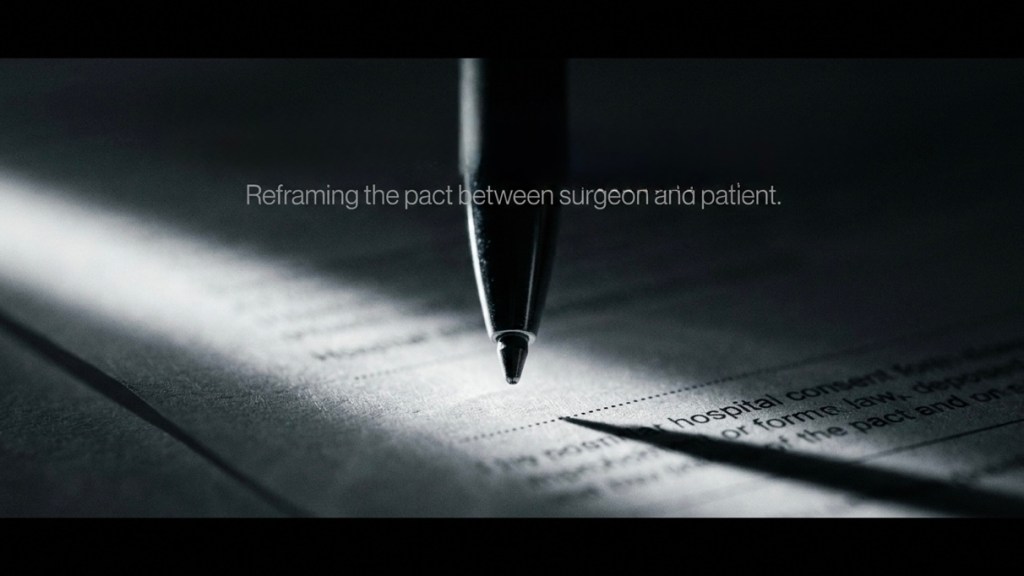
The consent form is in my hand. Its columns and signature lines already carry the faint imprint of the hospital stamp. It is a clinical tool. It is a legal shield. It is a common piece of paperwork. Yet in the quiet serious moment, I see it for what it truly is: a fragile commitment.
We are taught that surgery is a technical skill. It is a mix of anatomy, physiology, and mechanical precision. But the consent process shows the deeper truth of our work.
I have placed my name on hundreds of these forms over the years. Yet the moment the pen touches the paper still stops me. In truth, it marks a threshold. One person agrees to let another open his body. Both accept that certainty is never part of the deal.
I remember an elderly man. After I explained every possible risk with care, he folded the papers neatly. He said, “Doctor, I understand that you cannot promise success. I only ask that you do your best.” There was no simple hope in his words. He understood the limits of medicine, perhaps better than I did early in my career.
His words troubled me. For years, I thought consent was mainly about giving information to patients. But perhaps it is also about humbling surgeons. The signature on the paper does not free us from duty. It does not move the burden of uncertainty. Instead, it reminds us that our patients knowingly give their weakness to us.
There is a special silence in the pre-operative room when the patient picks up the pen. I have watched hundreds of hands pause over that line. They do not pause from doubt about the surgery. They pause because of the sudden private meeting with their own death that the paper brings out. When the pen finally touches the paper, the act is a deal. But it is also an acceptance of our shared mortality.
Each signature is a small giving up. The patient surrenders, even if only for a short time. Aristotle wrote that a free choice needs knowledge and no force. The consent form points to the first part. It can never fully escape the second. Especially when the patient in pain is scared and uncertainty looms large. And he is told there is no other way.
I try to steady and calm my voice as we speak. But I know these numbers are only a weak map of what lies ahead. The form cannot show the way a wife’s grip tightens when I mention a colostomy. It cannot show the silence after I ask, if there are any other questions. Those moments belong to the real talk. The printed page cannot sum them up.
Here I offer my skill — the ‘what’ and the ‘how’. But I cannot offer full assurance of the ‘if’. I know that I have walked this surgical path thousands of times. But for the person in front of me, this is their one terrifying and life-changing event.
Experience has taught me that no matter how carefully I explain, some uncertainty always remains. The future cannot be fully described. Suffering cannot be completely anticipated.
Even in emergency cases, when a family member signs because time is short, the form still asks for some ceremony. Someone must still speak the words and wait for an answer.
As I watch them sign, I feel humble. The ink dries. The legal protection is ready. But the moral agreement stays open. Consent is not the end of the talk. It is the start of a pact. We ask them to trust us with their life. In return, we owe them not just our surgical skill, but our full presence. It is a promise of honesty between two imperfect humans: one who seeks healing, the other who offers skill within the limits of science and self.
And after the operation, the real work of consent continues in the ward rounds. It continues in the honest answers about ongoing pain. It continues in the choice not to let hospital rules override good judgment. The signature was only the first step in a duty that paperwork cannot hold.
This is not an argument against the form. It is an argument for treating it seriously as more than just paperwork. The document lists risks — bleeding, infection, injury to nearby parts, death — as a plain list. I have begun reading those lines aloud differently than I once did, slower, with the gravity that “death” deserves when it appears on a page a frightened person is about to sign. The words do not change. The saying of them does.
I no longer rush through it as a preoperative necessity. I sit a little longer. I allow silence. I recognize that the patient before me is making an act of courage, one that often exceeds my own. In a world obsessed with control, this act of trust is extraordinary.
 Siddhartha Phukan – My Surgical World
Leave a comment